
More container purchases go wrong on delivery day than at any other point, and almost every one of those problems was visible on a satellite image a fortnight earlier. Choosing between a tilt-bed and a crane is not a preference. It is a decision that your access, your overhead clearance and your ground conditions have already made for you.
On this page
Two ways a container arrives
Nearly every land delivery uses one of two methods, and they impose completely different demands on your site. A tilt-bed needs length and a straight reversing line. A crane needs height and firm standing. Sites that suit one often rule out the other, which is why the answer comes from photographs rather than from preference.
Tilt-bed / roll-off
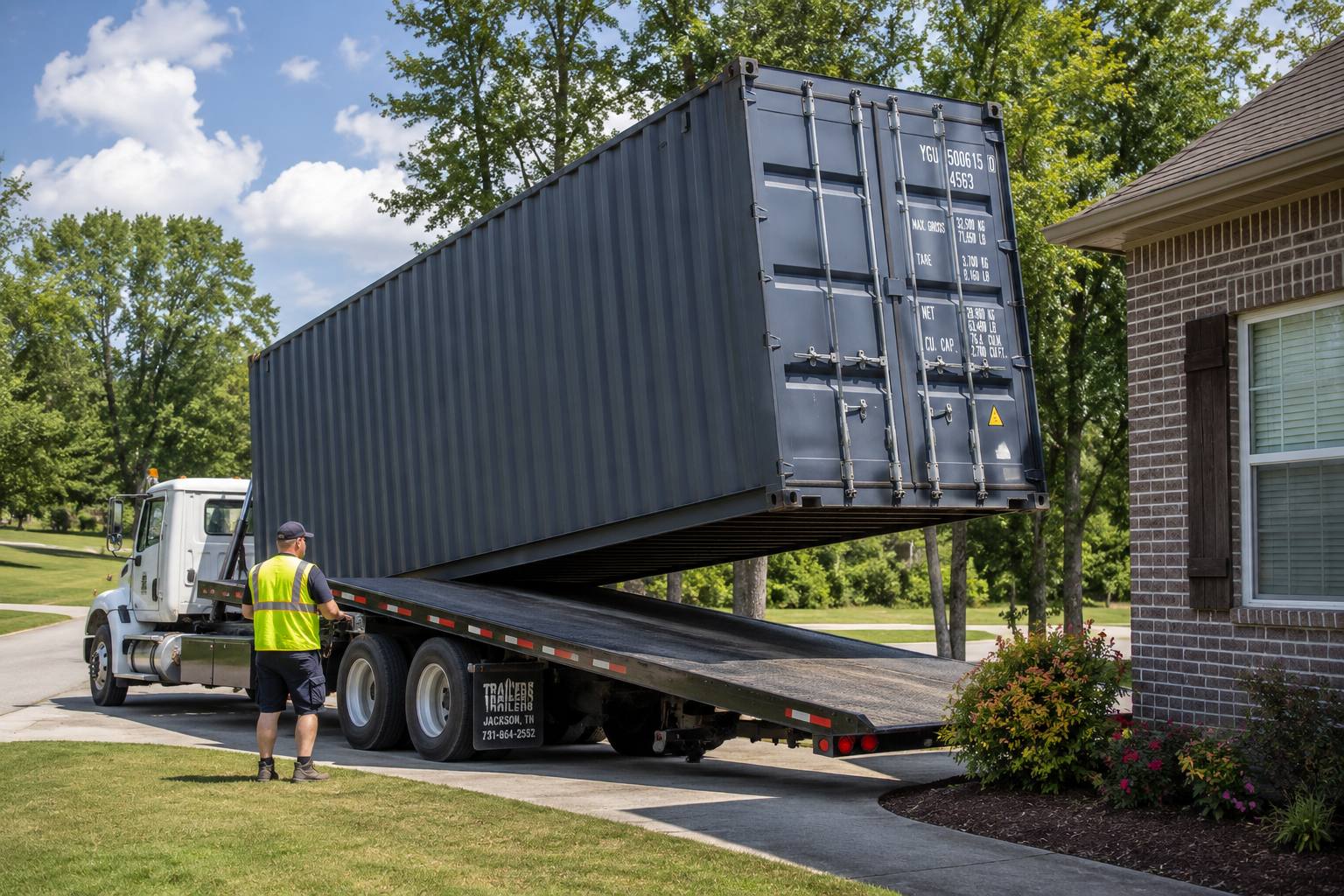
The trailer hydraulically tilts and the container slides off the rear onto the ground while the lorry pulls forward. One vehicle, one operation, lower cost, but it must reverse into the final line.
Crane or Hiab
A lorry-mounted crane lifts the container off the bed and places it. Costs more and needs overhead room and firm legs, but it can reach over fences, hedges, walls and even buildings.
Tilt-bed delivery
This is the standard method and the one to aim for. The driver reverses along the line the container will finish in, raises the bed, and lets the unit slide down onto your prepared base as the lorry creeps forward. It is quick, it needs no additional equipment, and on a decent access it is remarkably precise.
What it demands is a straight run. The container arrives in the orientation the lorry is pointing, so if your final position is at right angles to the gateway, a tilt-bed cannot help you. Allow roughly twice the container length in a straight line, because you need room for both the lorry and the container. Add clear width of around three metres, and remember the tilted bed rises high in the air, so overhead cables, branches and building overhangs matter as much as the ground.
- Straight line, twice the length. Lorry plus container, in one line, with nothing to swing around.
- Firm surface all the way. The vehicle is heavy and loaded. Soft ground that would hold the container will still strand the lorry.
- No overhead obstructions. The raised bed needs serious clearance. Cables and branches are the usual problem.
- Get the orientation right. Tell us which end the doors should face before the lorry arrives, not after.
- Prepare the base first. Piers cured, levels checked. Our foundations guide covers this in detail.
Crane and Hiab delivery
When the container has to go somewhere a lorry cannot reverse to, a crane earns its money. A Hiab or lorry-mounted crane lifts the unit from the bed and swings it into position, which means the vehicle can stand on the road or the driveway while the container lands behind a wall, over a hedge or in a back garden.
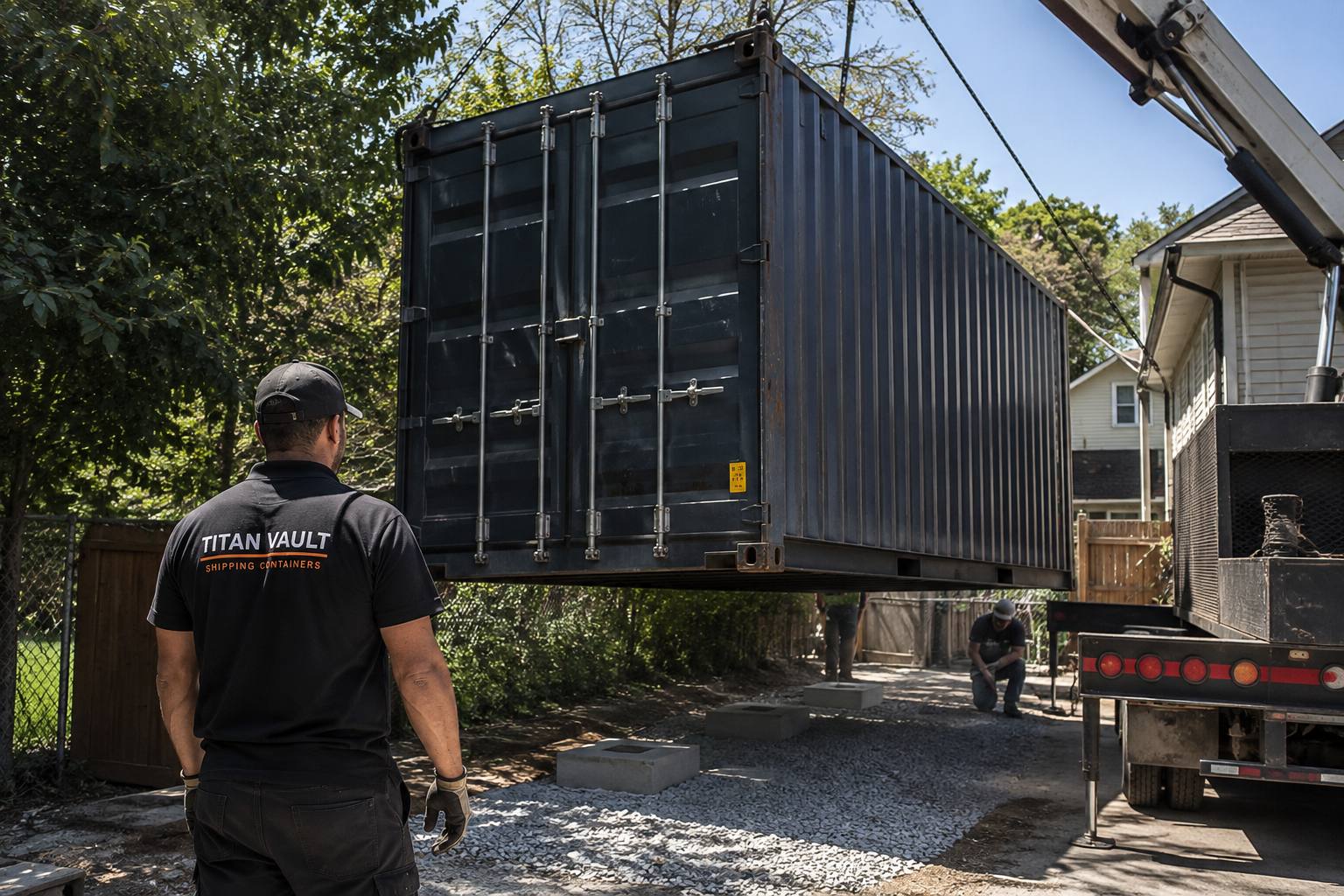
The controlling measurement is reach. A crane’s lifting capacity falls away sharply as the boom extends, so the distance from where the lorry can stand to where the container must land determines whether the lift is possible at all. That distance, plus the weight of the unit, is the first thing we need to know. The second is what is overhead: a lift needs genuine clear air above both the lorry and the landing point, and cables are an absolute stop.
- Measure the lift distance. From where the vehicle can realistically stand to the centre of the final position.
- Check what is above. Power lines, telephone lines, trees, eaves and canopies all rule out or reposition a lift.
- Firm standing for the legs. Outriggers concentrate enormous load into small pads. Soft verges and unsupported drain covers are a problem.
- Consider the weight. A 40ft high cube is around four tonnes empty, and a fitted-out unit considerably more.
- Allow more time. Setting up, lifting and packing away is a longer job than a slide-off.
Side by side
| Factor | Tilt-bed | Crane / Hiab |
|---|---|---|
| Cost | Lower | Higher |
| Access needed | Straight run, roughly twice the container length | Somewhere firm to stand within lifting reach |
| Overhead clearance | Needed for the raised bed | Needed for the full lift height and swing |
| Ground conditions | Must carry a loaded lorry along the whole route | Must carry the vehicle plus concentrated outrigger loads |
| Placement accuracy | Good, in the line of approach only | Excellent, in any orientation within reach |
| Reaching over obstacles | Not possible | This is the whole point |
| Typical duration | Short | Longer, with setup and packing away |
| Best for | Open yards, long driveways, straight gateways | Back gardens, walled sites, positions at right angles to access |
Measuring your access properly
Ten minutes with a tape measure and a phone camera prevents the single most expensive mistake in this whole process. An aborted delivery is charged for, and the container goes back to the depot.
Photograph the approach
Stand in the road and shoot towards the gateway, then walk in and shoot back out. Both directions matter.
Measure the narrowest point
Gateposts, bollards, parked cars, overhanging gutters. Record the actual clear width, not the nominal one.
Measure the overhead
Cables, branches, archways, canopies and signage. Height kills more deliveries than width.
Pace out the straight run
From the gateway to the final position, in a straight line. If you cannot get twice the container length, you are looking at a crane.
Assess the surface
Tarmac and concrete are ideal. Gravel is usually fine. Lawn, soft verges and freshly backfilled trenches are not.
Note the turning room
A rigid lorry needs less than an articulated one, but both need somewhere to swing and to leave.
Send us the photos: we look at delivery access every working day and we would far rather tell you it will not work a fortnight early than have a driver tell you on the morning. Our delivery photo library shows how tight some of these jobs actually are.
What actually drives the cost
Delivery pricing is not mysterious, but it is not driven by the things people expect. Container condition has no bearing on it at all.
Because distance matters most, the nearest depot with the right unit often beats a cheaper container further away. We quote delivered for exactly that reason, and our shipping policy sets out lead times, windows and how charges work.
On the day
Deliveries run to a window rather than a time, because the driver is working a route and traffic is traffic. You will normally get twenty-four to forty-eight hours of notice of the window. Someone who knows exactly where the container is going should be on site, because drivers will not guess, and repositioning a placed container usually means paying for another visit.
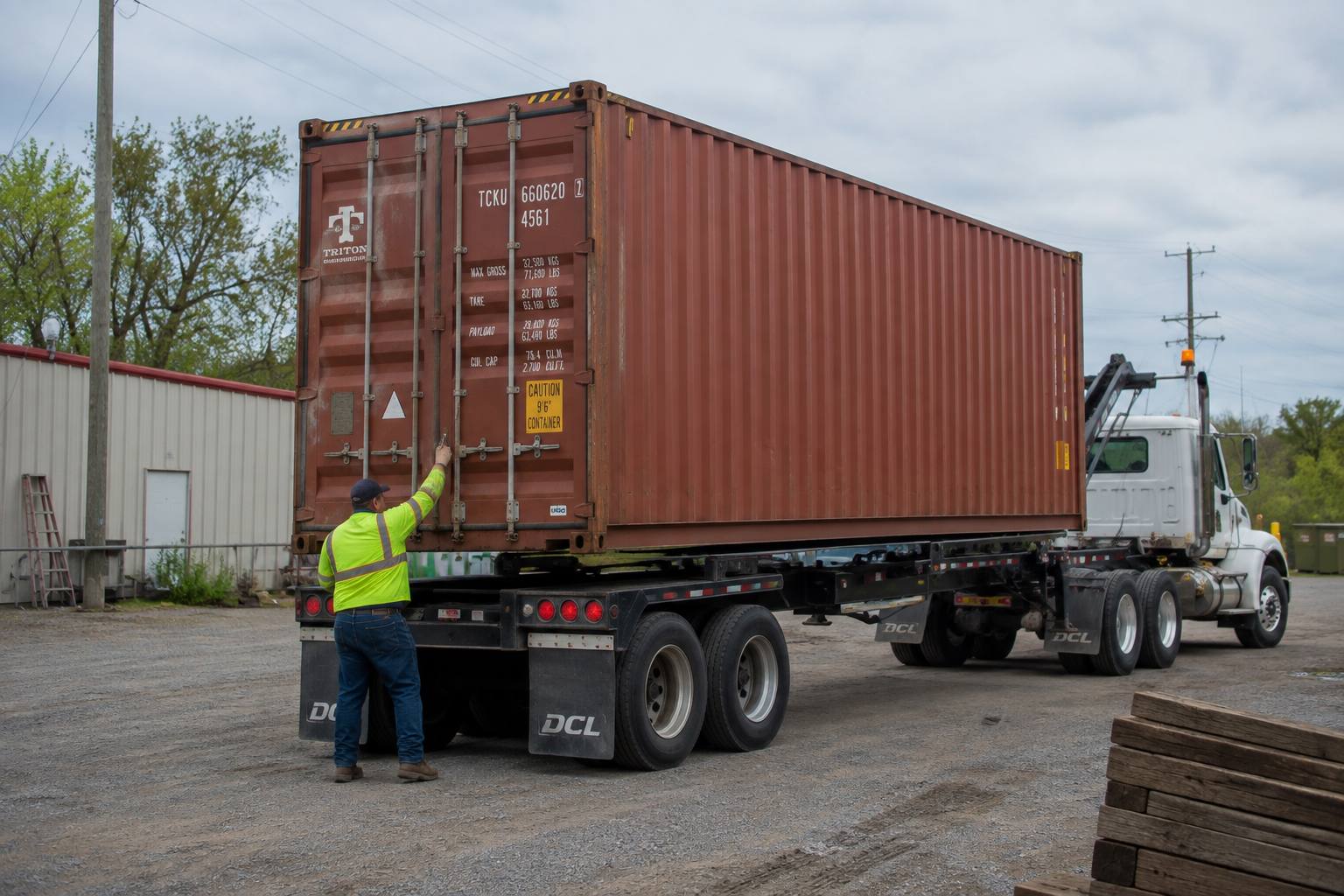
Have the route clear before the window opens: cars moved, gates unlocked, bins and wheelie bins out of the way, low branches cut back. Keep children and animals well clear of the operation. Mark the final position with paint, pegs or a couple of bricks so there is nothing to interpret. And once it is down, put a level on the floor straight away, because shimming a corner on day one takes minutes and correcting it later takes a crane.
Send your access photos before you order
Two or three photographs of the approach and the standing position are all we need to tell you which method suits, what it costs, and whether anything needs moving first.
Delivery questions answered
A tilt-bed lorry raises its trailer and slides the container off the back, so the vehicle has to reverse to the exact final position and needs run-off space behind it. A crane or Hiab lorry lifts the container over obstacles and places it, so the vehicle can stand further away but needs overhead clearance and firm ground to set its legs on.
Tilt-bed is normally the cheaper method because it is one vehicle and one operation with no lifting equipment. Crane delivery costs more but is often the only way to reach a position behind a fence, a hedge, a wall or a building. The cheapest delivery is always the one that works first time.
As a working guide, allow roughly twice the container length in a straight line for the lorry plus the container, a clear width of around three metres, and unobstructed overhead. A 20ft delivery therefore wants something like 20 metres of straight run and a 40ft delivery considerably more.
Yes, with a crane or Hiab, provided there is overhead clearance and the lift distance is within the machine’s rated reach. Reach and lifting capacity fall off sharply the further out the boom goes, so the distance from the vehicle to the final position is the critical measurement.
Someone should be, ideally the person who knows exactly where the unit is going. Drivers will not guess the position, and moving a container once it has been placed usually means paying for a second visit.
That is the scenario everyone wants to avoid, because an aborted delivery still costs money. It is entirely preventable: send us photographs of the approach, the gateway and the standing position before you order and we will tell you honestly whether it will work.